The Evolution of Connectivity: Mapping the Telecommunications Journey
From Morse Code to the Palm of Your Hand
In the grand tapestry of human history, few industries have undergone a transformation as radical and rapid as Telecommunications.
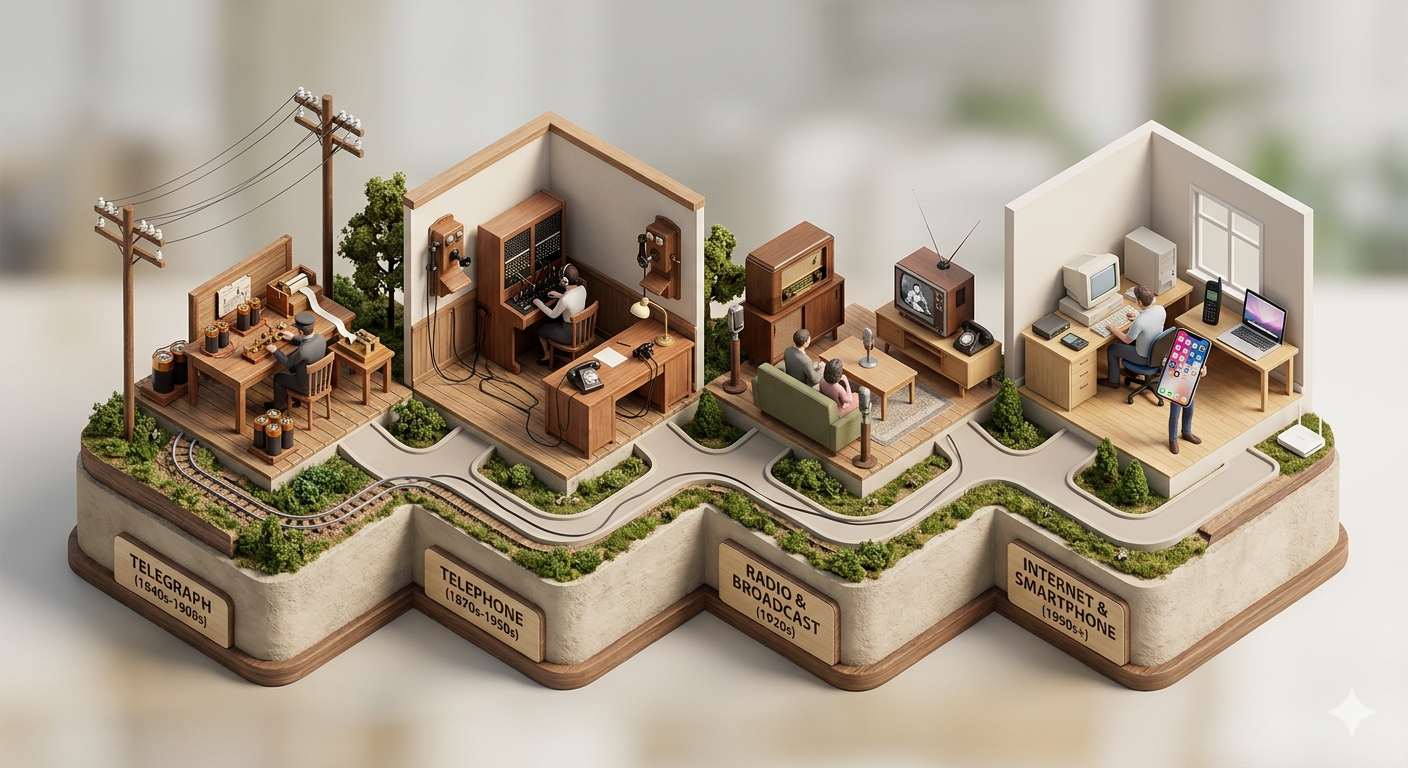
Looking at the visualization of this journey, it is staggering to realize how far we have come. What started as a series of rhythmic clicks on a wooden desk has evolved into a global, invisible web that connects billions of people in real-time. Understanding this evolution isn’t just a trip down memory lane—it’s a masterclass in how innovation reshapes society and business.
1. The Era of Dots and Dashes (1840s – 1900s)
The Telegraph was the world’s first “Internet.” Before its inception, information could only move as fast as a horse or a ship. By using Morse code to send electrical pulses over wires, we decoupled information from physical travel. This was the birth of near-instantaneous long-distance communication, fundamentally changing how news, commerce, and diplomacy functioned.
2. The Human Voice Unbound (1870s – 1950s)
The transition from the telegraph to the Telephone marked a shift toward a more human-centric technology. No longer restricted to codes, we could finally transmit the nuances of the human voice. This era saw the rise of massive infrastructure—manual switchboards and miles of copper wiring—that laid the foundation for the interconnected world we live in today.
3. The Power of Mass Media (1920s – 1980s)
Telecommunication wasn’t just about one-to-one conversation; it became about one-to-many. The rise of Radio and Television Broadcasts created a shared global consciousness. For the first time, a single event could be witnessed by millions simultaneously. This era democratized information and transformed the advertising and entertainment industries forever.
4. The Digital Revolution & Convergence (1990s – Present)
Today, we are in the era of Total Connectivity. The “Smartphone” isn’t just a phone; it is a telegraph, a radio, a television, and a high-powered computer combined into one pocket-sized device. With the advent of the Internet, 5G, and IoT, the barriers of time and space have effectively dissolved. We are now communicating across borders with high-definition video, instant data transfers, and seamless collaboration tools.
Why This Matters for the Future
This journey illustrates a clear trend: Communication is becoming faster, more personal, and increasingly accessible. As we look toward the future of 6G, Satellite Internet, and AI-driven communication, the lesson remains the same—those who adapt to the latest methods of connection are the ones who lead the market.
What do you think the next stage in this visualization will look like? Whether it is Neural-link communication or decentralized networks, the next chapter of human connection is already being written.